The first minutes of any law enforcement activation determine what options remain available as the situation develops. A first response team that arrives at an incident with aerial intelligence already streaming to the command post operates with a fundamentally different level of capability than one arriving without it they know what is ahead of them before they step into it, and that knowledge changes every decision that follows.
aerosmart supplies DJI enterprise drone systems to law enforcement first response teams across 14+ African countries systems that get airborne in under a minute, feed real-time thermal and visual intelligence to the incident commander, and extend the operational capability of first response units in Nigeria, Kenya, Ghana, Ethiopia, Uganda, Tanzania, Rwanda, Zambia, and beyond.
Africa's law enforcement agencies face a first response challenge that differs significantly from the environments that European and North American tactical drone doctrine was built around. Response distances are larger. Road access to incident locations is frequently compromised by traffic, terrain, or infrastructure quality. Helicopter support is either unavailable at the response unit level or carries lead times that render it irrelevant to an incident that has already evolved significantly by the time air support arrives.
In Nigeria's Abuja and Lagos metropolitan areas, in Nairobi's dense residential neighbourhoods, in Accra's mixed commercial-residential zones, and in the informal settlement areas of Kampala and Addis Ababa a first response unit arriving at an active incident without aerial intelligence is operating in a tactical environment where the subject, the bystanders, and the physical layout of the scene are all unknown at the moment of arrival. The first seconds on scene are spent acquiring information that should have been acquired before the unit arrived.
A drone carried in the response vehicle, airborne before the vehicle reaches the scene perimeter, changes this. The first response commander sees the scene layout, the subject's position, and the bystander distribution before the unit deploys from vehicles. The tactical decision how to approach, where to position, what to expect is made with information rather than in its absence.
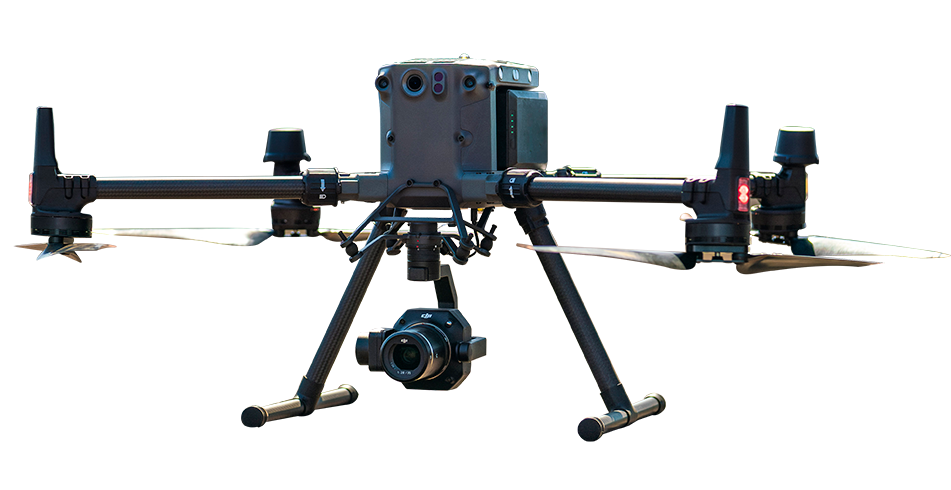
The Matrice 4T's 1.2 kg weight, 30-second deployment time, and integrated multi-sensor suite visible, thermal, and tele cameras with an 1,800-metre laser rangefinder make it the first response drone that fits in the patrol vehicle rather than requiring a specialist vehicle to transport it. The responding officer carries it from the vehicle, launches it at the scene perimeter, and has live aerial intelligence feeding to the controller and to the command post through DJI FlightHub 2 before the ground unit moves in.
For African first response operations, the Matrice 4T covers the scenarios that occur without warning the domestic violence call that arrives at an unknown residential address, the vehicle pursuit that enters a residential area, the public disorder call at a market or gathering, and the armed incident at premises where the internal layout is unknown. In each case, the drone goes in ahead of the ground unit and provides the 90-second situational picture that changes the tactical approach from reactive to informed.
African wet seasons, coastal humidity events, and harmattan conditions create first response scenarios where the weather cannot be waited out and the incident cannot be paused. The Matrice 30T's IP55 protection keeps the aerial asset operational in the conditions that African first response teams actually operate in not just the ideal deployment conditions that specifications are measured against.
Hot-swappable batteries allow continuous aerial presence at an extended incident without landing when the first battery depletes, a second is swapped without the aircraft touching down, maintaining uninterrupted visual and thermal coverage of the scene throughout the battery transition. For African first response incidents that extend beyond a single battery cycle, this continuity matters operationally.
Smart Track maintains camera lock on a moving subject automatically reducing the cognitive demand on the pilot who is simultaneously managing the aircraft, monitoring multiple camera feeds, and communicating with ground teams. For first response teams where the drone pilot may be a secondary function of an officer managing other tactical responsibilities, reduced pilot workload is a practical operational requirement.
The responding officer launches the Matrice 4T or 30T at the scene perimeter. DJI Pilot 2 guides the aircraft to the pinned incident GPS coordinate using AR overlay. The incident commander switches between thermal and visible camera views to locate subjects, identify bystanders, and assess the scene layout. Smart Track locks onto the primary subject of interest. The FlightHub 2 live stream feeds the command post simultaneously the on-scene pilot and the off-scene commander see the same picture in real time. Post-incident, all imagery and video is available in FlightHub 2 for evidence documentation, incident reporting, and tactical debrief without additional processing steps.
Compare DJI enterprise drone platforms for rapid urban deployment, extended incidents, adverse weather operations and high-priority planned law-enforcement response missions across Africa.
| Scenario | Platform | Key Capability |
|---|---|---|
| Urban first response |
DJI Matrice 4T
|
30-second deployment, integrated multi-sensor system and lightweight 1.2 kg platform |
| Extended or wet-weather incident |
DJI Matrice 30T
|
IP55 protection, hot-swappable batteries and Smart Track subject monitoring |
| High-priority planned response |
DJI Matrice 400 + Zenmuse H30T
|
Up to 59 minutes of flight time, 34× optical zoom, long-range laser rangefinding and thermal imaging |
DJI enterprise drones provide first-response teams with real-time aerial situational intelligence before ground units deploy. Visible and thermal camera feeds help reveal the incident layout, subject positions, possible access routes and the locations of bystanders. A responding officer can launch the drone from the scene perimeter and begin receiving live aerial information within approximately 30 seconds of deployment.
The DJI Matrice 4T is suited to rapid urban first-response operations because of its lightweight 1.2 kg design, approximately 30-second deployment time and integrated visible, thermal and telephoto camera system. The DJI Matrice 30T is better suited to extended incidents and weather-affected environments that require IP55 protection, battery replacement capability and Smart Track subject monitoring.
Yes. The DJI Matrice 30T has an IP55-rated design that supports operations in rain, dust and humid conditions, making it suitable for incidents that cannot be delayed because of changing weather. The DJI Matrice 4T is suited to most fair-weather and light-weather first-response deployments, provided operations remain within the aircraft's specified environmental limits and applicable aviation regulations.

Fill in your details below and our team will get back to you
with a personalized quote.