

Africa's wind-energy sector is becoming an increasingly important part of the continent's electricity-generation mix. Wind farms such as Morocco's Tarfaya and Jbel Khalladi projects, Kenya's Lake Turkana Wind Power project, Ethiopia's Adama wind farms, Egypt's Gulf of Suez installations and projects across South Africa's Western and Northern Cape all require regular inspection to maintain blade performance and identify damage before it develops into a more serious structural problem.
Traditional wind-turbine blade inspection commonly involves rope-access technicians working from the hub or nacelle. This process requires specialist rigging, trained personnel and extended turbine downtime while exposing technicians to work-at-height hazards. Across a large wind farm, the time, cost and logistical requirements of inspecting every turbine can be substantial.
DJI enterprise drone inspection can reduce the time required for routine blade-condition documentation and limit the need for initial rope-access inspection. Close-range visual and thermal imagery helps inspection teams identify leading-edge erosion, cracks, lightning-strike damage, coating defects and other visible or temperature-related anomalies for further engineering assessment.
Effective wind-turbine blade inspection requires systematic coverage of the complete blade surface at a consistent and controlled standoff distance. Each blade face should be documented at sufficient resolution to support the identification of leading-edge erosion, visible cracks, coating damage, delamination indicators and lightning-strike impact zones. Inspections are normally conducted while the turbine is stopped and the blades are positioned according to the approved inspection procedure.
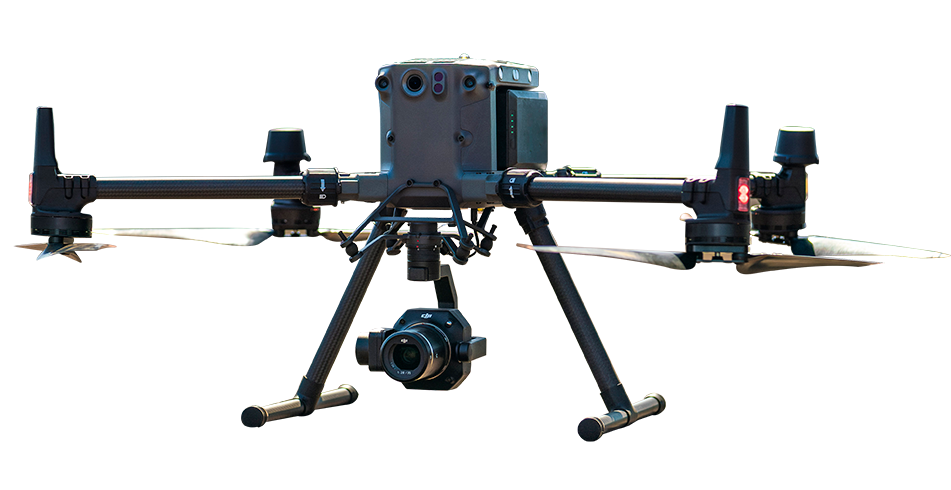
The DJI Matrice 400 provides an enterprise platform for close-range infrastructure inspection. When operated by a qualified remote pilot under an approved mission plan, its sensing and positioning systems can support controlled flight around the turbine structure. The Zenmuse H30T's zoom camera captures detailed blade imagery that can support defect measurement, severity classification and formal inspection reporting.
The H30T thermal camera may also help identify abnormal temperature patterns associated with moisture ingress, subsurface delamination or other internal conditions that are not readily visible in standard imagery. Thermal findings should be interpreted by qualified personnel and confirmed through the wind-farm operator's established inspection and maintenance procedures.
For operators managing large wind farms, a structured drone inspection programme can organise turbines into daily mission batches. Each turbine can be assigned a repeatable inspection route and a complete image record covering all three blades, allowing findings to be compared between inspection cycles.
Daily productivity depends on turbine height, blade length, wind conditions, required image resolution, battery rotation, site layout and local aviation requirements. An experienced team using the DJI Matrice 400 can inspect multiple turbines during one operating day, but the expected output should be established through a site-specific mission plan rather than treated as a fixed number.
High-resolution drone imagery can support the identification of leading-edge erosion, surface cracks, coating loss, impact damage, lightning-strike marks, trailing-edge separation and visible deformation. Capturing each finding with its turbine number, blade reference and approximate blade position creates a consistent record for maintenance planning.
Inspection data can be reviewed to classify defects by type, location and apparent severity. This helps asset managers prioritise turbines for closer engineering review, rope-access confirmation or repair, while retaining a digital baseline for future condition comparisons.
Repeating the same inspection workflow at scheduled intervals helps wind-farm operators track the progression of known defects. Imagery captured during different inspection cycles can be compared to determine whether erosion, cracking or coating damage appears stable or is continuing to develop.
This repeatable digital record supports preventive maintenance and helps operators decide when a defect can remain under observation and when physical access, non-destructive testing or repair should be scheduled.
Kenya's Lake Turkana Wind Power project: Large turbine fleets require a structured inspection programme that can document blade condition efficiently across many assets while maintaining consistent inspection records.
Morocco's Atlantic wind corridor: Wind farms operating in coastal environments may experience accelerated leading-edge erosion, salt exposure and coating degradation, making periodic high-resolution blade inspection particularly valuable.
South Africa's utility-scale wind farms: Repeatable drone surveys can support condition-based maintenance programmes by providing digital blade records that can be compared from one inspection cycle to the next.
Compare conventional rope-access inspections with DJI enterprise drone inspections for wind-turbine blade assessment across Africa.
| Factor | Rope Access | DJI Drone Inspection |
|---|---|---|
| Time per turbine | Typically several hours | Often completed in less time, subject to the inspection scope |
| Personnel per turbine | Multiple specialist personnel | Qualified remote-pilot and inspection team |
| Work-at-height exposure | Direct personnel exposure | Reduced for routine visual inspection |
| Image quality | Depends on manual image capture | Repeatable imagery from a controlled standoff distance |
| Coverage consistency | Manual inspection workflow | Systematic blade-surface documentation |
| Data record | Notes and manually captured photographs | Structured digital imagery dataset |
DJI enterprise drones can perform systematic close-range inspection passes across each blade surface while maintaining a controlled standoff distance. High-resolution zoom imagery can help identify leading-edge erosion, visible cracks, lightning-strike damage, coating defects and other surface conditions. Compatible thermal cameras may also support the detection of temperature patterns associated with subsurface delamination or moisture ingress, although all findings should be reviewed and confirmed by qualified wind-turbine inspection personnel.
Daily inspection capacity depends on turbine height, blade size, required image resolution, weather, battery rotation, site layout, flight restrictions and the inspection procedure being followed. With an experienced operating team and an efficient workflow, a DJI Matrice 400 can support the inspection of multiple turbines during one operating day. The expected number should be calculated through a site-specific mission plan rather than treated as a fixed daily rate.
Drone inspection can replace rope access for many routine blade-condition surveys and initial defect-identification tasks. It provides detailed visual documentation while reducing inspection time and personnel exposure to work-at-height hazards. Rope access may still be required when technicians need to physically confirm, test or repair a defect. In practice, drone inspection helps identify and prioritise the blade areas that require closer manual access.

Fill in your details below and our team will get back to you
with a personalised quote.