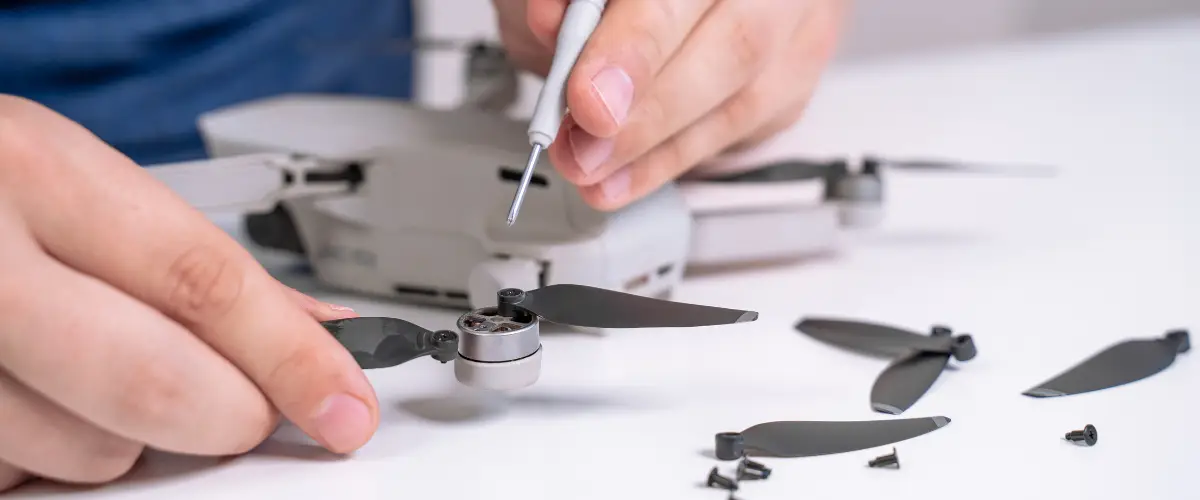
A grounded enterprise drone can interrupt surveys, inspections, agricultural applications, public-safety missions and other time-sensitive operations. Aerosmart Africa provides structured diagnostic, repair-coordination and preventive-maintenance support to help enterprise operators reduce avoidable downtime.
Our service scope covers crash-damage assessment, structural and propulsion repairs, payload and gimbal servicing, firmware and software troubleshooting, battery-health assessment, DJI Agras application-system maintenance and scheduled fleet inspections.
Remote diagnosis is used wherever practical to identify warning messages, configuration issues and likely hardware faults before equipment is shipped. When physical service is required, Aerosmart Africa can provide packaging, customs-documentation and logistics guidance for routing equipment through the designated service channel.
Repair scope, turnaround time, component availability and DJI Care Enterprise eligibility are confirmed after the relevant technical assessment. Final service arrangements may vary by product and destination country.
Aerosmart Africa supports a broad range of DJI Enterprise, DJI Agriculture and DJI Delivery platforms. Final service capability is confirmed after reviewing the product model, fault type, component availability and applicable service route.
DJI Matrice 400: Service support may include propulsion-system inspection, motor and ESC diagnostics, payload-port assessment, sensing-system checks, battery-system evaluation, transmission troubleshooting and enclosure or seal inspection following impact or environmental exposure.
DJI Matrice 350 RTK: Inspection may cover propulsion, dual-battery operation, RTK and positioning-system status, IMU alignment, payload connections, gimbal interfaces and structural condition.
DJI Matrice 30 / Matrice 30T: Support may include motor and propulsion servicing, integrated payload diagnostics, gimbal calibration, battery assessment, transmission checks and enclosure-seal inspection.
DJI Matrice 4 Series: Service may include propulsion alignment, integrated visible and thermal sensor checks, gimbal calibration, RTK verification, battery-system assessment and aircraft-to-dock integration checks for compatible Matrice 4D and 4TD systems.
DJI Matrice 300 RTK: Support remains available for selected propulsion, RTK, IMU, payload-port, battery and communication-system requirements, subject to diagnosis and component availability.
DJI Agras aircraft operate in chemically aggressive, dusty and high-cycle environments. Maintenance therefore needs to address the complete aircraft and application system rather than the airframe alone.
Supported Agras platforms: Service may be available for DJI Agras T100, T70P, T50, T25P, T25 and other compatible models, depending on regional availability and the diagnosed repair requirement.
Propulsion and Airframe: Motor and ESC diagnostics, propeller inspection, arm and frame assessment, landing-system checks and structural repair evaluation.
Spray and Spreading Systems: Tank, seal, filter, hose, pump, atomiser, nozzle and flow-path inspection, together with spreading-system cleaning, component checks and application-rate calibration where supported.
Battery and Safety Systems: Battery-health review, charging-system checks, positioning and RTK status, radar or sensing-system diagnostics and terrain-following verification where applicable.
Dock servicing may include enclosure and seal inspection, environmental-control checks, charging-contact assessment, internal camera verification, network and communication diagnostics, aircraft-dock alignment checks and FlightHub 2 integration support.
Cargo-drone service may include propulsion and ESC inspection, battery-system assessment, structural checks at high-stress points, cargo-release or winch-system servicing, communication diagnostics and supported sensing-system verification.
Inspection and repair coordination may be available for selected Zenmuse payloads, including H30 Series, H20 Series, H20N, L3, L2, P1, S1 and V1. Service scope depends on the payload, diagnosed fault, calibration requirement and available repair channel.
Zenmuse H30 / H30T: Gimbal motor and bearing replacement, thermal-camera calibration, non-uniformity correction, zoom-camera optical alignment, laser-rangefinder calibration, NIR auxiliary-light testing and inspection of the all-weather housing seals that support the H30 Series environmental protection.
Zenmuse L2 / L3: LiDAR sensor-housing inspection, IMU calibration verification, RGB-camera gimbal and mechanical-shutter inspection, synchronisation-system diagnostics and verification of the precision alignment between the IMU and laser head required for accurate survey data.
Zenmuse P1: Full-frame sensor inspection, mechanical-shutter function and timing verification, DL lens-mount integrity assessment, gimbal calibration and RTK synchronisation diagnostics supporting accurate TimeSync workflows.
Zenmuse H20 / H20T / H20N: Gimbal bearing and motor replacement, thermal-camera calibration, zoom-camera optical alignment and laser-rangefinder calibration. For the H20N, service may also include inspection and calibration of its starlight and dual-thermal imaging systems for reliable night-time operation.
Zenmuse S1 / V1: LEP light-source assessment and housing inspection for the Zenmuse S1, together with speaker-driver and anti-howling system verification for the Zenmuse V1. Gimbal, mounting and connection-system inspections are also completed where applicable.
Crash damage is one of the most urgent categories of drone repair. It can include aircraft involved in collisions, hard landings, propeller strikes or controlled-flight-into-terrain incidents. Aerosmart Africa begins each crash repair with a complete structural, electrical and operational assessment before repair work is quoted or commenced.
Initial Assessment: The aircraft is inspected for visible structural damage, including cracked frames, bent arms, damaged propellers, landing-gear deformation, gimbal mount damage and payload-port damage. Internal systems are also checked for electrical or electronic faults that may not be externally visible, including ESC damage, motor overload, IMU impact damage, GPS antenna connection faults and damaged payload interfaces.
Structural Repair: Damaged structural components are replaced using suitable genuine DJI parts wherever available. Repairs may include frame replacement, arm and motor-mount replacement, landing-gear repair and restoration of the gimbal isolation system. Correct component fit, rigidity and weight distribution are important for flight stability, vibration control and payload performance.
Post-Repair Calibration: After structural and electronic repairs are completed, the aircraft undergoes the required IMU, compass and gimbal calibration procedures. RTK, positioning and payload systems are also checked where applicable. A controlled test flight and flight-log review are then completed to confirm stable aircraft behaviour before return to operational service.
Drone motors are high-wear mechanical components that can be affected by bearing wear, vibration, dust, moisture, agricultural chemicals, overheating and impact damage. Aerosmart Africa provides motor and propulsion-system inspection, cleaning, repair and replacement based on the condition of the aircraft and the manufacturer's service requirements.
Motor Assessment: Motors are checked for abnormal vibration, bearing noise, shaft movement, contamination, corrosion, overheating and impact-related deformation. Electrical testing may also be carried out to identify winding damage, resistance imbalance or faults caused by excessive load or thermal stress.
Motor Service and Replacement: Worn but serviceable motors may be cleaned and inspected for bearing or mechanical faults. Where damage, corrosion, shaft deformation or electrical degradation exceeds safe service limits, the complete motor assembly is replaced using compatible genuine DJI components where available.
ESC Diagnostics: The Electronic Speed Controller is tested for motor-control faults, overheating, current irregularities, communication errors and unstable performance. ESC replacement may be required where diagnostics identify thermal damage, electrical failure or control behaviour that cannot be corrected through standard servicing.
Propeller Assessment: Propellers are inspected for cracks, chips, surface damage, deformation, imbalance and incorrect blade symmetry. Even minor damage can affect flight stability, vibration levels and motor loading, so damaged or questionable propellers should be replaced rather than repaired.
Propeller Replacement: Replacement is carried out using the correct DJI propeller model specified for the aircraft. Correct propeller size, pitch, mounting direction and installation are essential for safe operation and proper flight-controller performance.
Post-Service Testing: After motor, ESC or propeller work is completed, the propulsion system is checked for smooth startup, consistent motor response, abnormal vibration, warning messages and stable operation. A controlled test flight may also be completed before the aircraft is returned to service.
Drone batteries are consumable components whose available capacity and performance gradually decline through charge cycles, storage conditions, deep discharge, high operating temperatures and field charging. Aerosmart Africa provides battery-health assessment, replacement support and practical battery-management guidance for DJI enterprise drone operations.
Battery Health Assessment: Each battery pack is checked for cell-voltage balance, warning messages, charge-cycle history, swelling, physical damage, connector condition and abnormal temperature behaviour. Internal resistance and usable capacity may also be measured to identify deterioration that can reduce flight time or affect safe operation.
Capacity and Performance Testing: Battery performance is assessed against the expected condition of the pack, taking into account its age, cycle count, storage history and operating environment. Batteries showing excessive imbalance, reduced capacity, swelling, overheating or persistent system warnings should be removed from service and replaced.
Battery Reconditioning: Where supported by the battery model and manufacturer procedures, servicing may include controlled charging, balancing, firmware checks and repeated diagnostic testing. Physical cell repair, dismantling or unauthorised rebuilding of DJI intelligent batteries is not recommended because it can compromise safety and battery-management protection systems.
DJI Care Enterprise Battery Replacement: Where eligible under the applicable DJI Care Enterprise plan, Aerosmart Africa can assist with battery-replacement claims, documentation, claim submission, replacement coordination and the return process for the original battery. Coverage, replacement limits and eligibility depend on the specific DJI Care plan, aircraft, region and active service terms.
Battery Management Guidance: Operators receive guidance on recommended storage charge, temperature control, charging intervals, transport, inspection routines and cycle management. Correct storage and charging practices are especially important in hot climates, where prolonged heat exposure can accelerate battery degradation.
Field Charging Recommendations: For remote operations using generators, mobile power systems or temporary charging stations, the power supply should provide stable voltage and sufficient capacity for the approved DJI charging equipment. Batteries should be charged in a ventilated, shaded and supervised location away from flammable materials.
DJI enterprise firmware updates may introduce performance improvements, compatibility updates, new capabilities and important system corrections. Keeping aircraft, remote controllers, payloads, batteries and connected software on compatible firmware versions helps maintain reliable operation across the complete drone system.
Firmware Update Service: Aerosmart Africa provides supervised firmware updates using the DJI-recommended software and update procedures for compatible aircraft, payloads, remote controllers, batteries and docking systems. Before updating, the current firmware versions, system compatibility, battery condition and network requirements are reviewed.
Post-Update Verification: After installation, the aircraft and connected components are checked for firmware consistency, warning messages, communication faults and abnormal system behaviour. IMU, compass, gimbal, payload and positioning systems are also reviewed, with recalibration completed where required before the equipment returns to operational service.
DJI Pilot 2 Troubleshooting: Support includes aircraft activation, account access, device linking, payload recognition, flight-mode configuration, map and network settings, firmware compatibility, warning-message investigation and other DJI Pilot 2 configuration issues.
DJI FlightHub 2 Support: Aerosmart Africa can assist with organisation setup, device binding, user permissions, live-stream connectivity, cloud-data synchronisation, mission planning, media upload and supported remote-operation workflows.
DJI Terra Troubleshooting: Support may include licence activation, project configuration, data import, processing errors, coordinate-system settings, hardware compatibility and workflow setup for photogrammetry, LiDAR and agricultural mapping projects.
DJI Dock 3 Integration Diagnostics: Dock support includes aircraft and dock binding, network connectivity, FlightHub 2 integration, mission scheduling, charging behaviour, weather data, remote-operation settings and investigation of system warnings that may affect autonomous workflows.
Remote Technical Support: Many software and configuration issues can be investigated remotely through screen sharing, video calls, diagnostic screenshots and approved remote support tools. Where the issue involves hardware failure, physical damage or a safety-critical fault, the equipment may need to be inspected at an authorised service location.
Compatibility and Update Planning: Firmware should not be updated immediately before a critical mission without sufficient time for testing. Operators should confirm aircraft, payload, remote-controller and software compatibility, complete a controlled system check and review relevant release notes before operational deployment.
The spray system is one of the most important working components on a DJI Agras agricultural drone. Repeated exposure to crop-protection chemicals, fertilisers, suspended particles and hard water can cause residue buildup, seal degradation, flow restrictions and uneven application. Aerosmart Africa provides complete spray-system inspection, cleaning, calibration and component replacement from the tank through to the nozzle assemblies.
Tank Inspection and Cleaning: The spray tank is inspected for chemical residue, mineral deposits, contamination, surface deterioration and damage around outlets, filters and fittings. Cleaning is carried out using a process suitable for the chemicals previously used in the system and in accordance with the applicable product-safety requirements.
Tank Seals and Connections: O-rings, gaskets, hoses, clamps, valves and tank connections are checked for swelling, cracking, compression damage, leaks and chemical degradation. Worn sealing components are replaced with compatible parts to restore a secure flow path.
Pump Inspection and Service: Pump assemblies are checked for restricted flow, abnormal noise, leakage, impeller wear, contamination and irregular motor-current behaviour. Flow output is compared with the expected operating condition, and the pump is cleaned, serviced or replaced where performance falls outside safe serviceable limits.
Filter and Flow-Path Cleaning: Filters, hoses, connectors and internal flow channels are inspected and flushed to remove chemical residue, sediment and particulate contamination. Blocked or damaged components are replaced where cleaning cannot restore reliable flow.
Nozzle and Atomiser Service: Centrifugal sprinkler discs, atomisers and nozzle assemblies are inspected for residue buildup, wear, imbalance and restricted rotation. Cleaning, rotational checks, spray-angle inspection and distribution-pattern testing are completed to confirm consistent atomisation.
Cooling-Circuit Inspection: Where the spray system includes a cooling circuit, the associated lines and passages are inspected and flushed. Restricted cooling flow can affect nozzle performance and component life, particularly during extended agricultural operations.
Nozzle Replacement: Nozzle or atomiser assemblies are replaced when wear, corrosion, mechanical damage or inconsistent spray output cannot be corrected through cleaning and calibration. The correct compatible component must be used for the specific Agras platform and application system.
Flow-Rate Calibration: The complete spray system is tested from tank to nozzle to confirm that the delivered flow rate corresponds with the application settings configured in the mission-planning system. Calibration helps reduce the risk of under-application, over-application and uneven field coverage caused by component wear or partial blockage.
Distribution and Leakage Testing: After servicing, the system is checked for stable pressure, balanced output, consistent atomisation, leaks and warning messages. A controlled water-only test should be completed before the aircraft is returned to chemical application work.
Variable-Rate Application Verification: Where prescription maps or variable-rate missions are used, the configured application settings and actual spray-system response are reviewed together. Agronomic rates, chemical labels and field application plans should always be confirmed by a qualified agronomist or crop-protection specialist.
Preventive maintenance helps identify wear, contamination, calibration issues and component deterioration before they cause operational failure. Aerosmart Africa provides scheduled maintenance programmes based on aircraft type, flight hours, mission profile, environmental exposure and seasonal operating demands.
Maintenance intervals should reflect actual operating conditions. Dust, humidity, high temperatures, chemical exposure, frequent transport and intensive seasonal use can accelerate wear on motors, batteries, seals, payloads and agricultural application systems.
Monthly Inspection Package: Includes propulsion-system inspection, battery-health and cell-balance checks, gimbal and payload-port inspection, firmware-version verification, structural fastener checks and sensor-calibration status review.
Propulsion and Structural Checks: Motors, propellers, arms, landing gear and mounting points are inspected for wear, looseness, vibration, corrosion, contamination and impact damage. Components that fall outside safe service limits are recommended for repair or replacement.
Battery and Charging-System Checks: Batteries are reviewed for cycle count, cell imbalance, swelling, abnormal temperature behaviour, warning messages and connector condition. Charging hubs, power supplies and field-charging equipment are also inspected for damage, unstable output and ventilation issues.
Quarterly Service Package: Includes detailed inspection of motors, bearings, windings, ESC behaviour, propellers, payload systems, environmental seals and battery performance. Battery resistance and capacity trends may also be recorded to identify packs approaching the end of their safe service life.
Payload and Gimbal Service: Gimbal movement, motor response, bearings, vibration isolation, payload connectors and mounting systems are checked for wear and abnormal operation. High-cycle equipment may require deeper servicing or component replacement.
Environmental-Seal Inspection: Housings, access covers, connectors, gaskets and seals are inspected for cracking, compression damage, contamination and incorrect seating. This is particularly important for equipment used in dusty, humid, coastal or high-rainfall environments.
DJI Agras Spray-System Inspection: Agricultural platforms receive inspection of tanks, filters, hoses, pumps, valves, atomisers and flow paths. Residue buildup, leakage, restricted flow and uneven output are identified before they affect application accuracy or field reliability.
Annual Overhaul Package: Includes a comprehensive structural, electrical and mechanical inspection of the aircraft and its major systems. The service may include deeper disassembly, recalibration, bearing assessment, battery-capacity testing and crack inspection at high-stress points.
Calibration and System Verification: IMU, compass, gimbal, positioning and RTK systems are checked and recalibrated where required. Firmware compatibility is verified across the aircraft, payload, remote controller, batteries and connected software before the system returns to service.
Annual DJI Agras Overhaul: Agricultural drone servicing may include complete spray-system inspection, tank and seal assessment, pump and atomiser testing, flow-path cleaning, flow-rate calibration and replacement of worn application components.
DJI Care Enterprise Support: Aerosmart Africa can assist with eligibility reviews, renewal processing and claim coordination for applicable DJI Care Enterprise plans. Coverage and service conditions depend on the active plan, aircraft model and regional terms.
Maintenance Records and Service Planning: Inspection results, replaced components, battery trends, calibration status and recommended actions can be documented to support maintenance planning and reduce unplanned operational downtime.
DJI Care Enterprise Plus is an enterprise protection plan that provides eligible DJI products with repair coverage for accidental damage during the active service period. Depending on the product, region and applicable plan terms, benefits may include unlimited free repairs within the available coverage amount, shared fleet coverage and two-way shipping support.
Aerosmart Africa can assist customers with DJI Care Enterprise Plus activation, eligibility checks and service-claim coordination for supported DJI enterprise products. Our team can help prepare claim information, coordinate repair or replacement processing and manage the associated logistics where the service is available.
DJI Care Enterprise availability, activation requirements, coverage limits, supported products and service benefits vary by country and plan. Coverage should therefore be confirmed before purchase or activation.
| Benefit | Detail |
|---|---|
|
Unlimited repairs
|
An unlimited number of eligible free repairs may be provided during the service period, subject to the available coverage amount and applicable plan terms. |
|
Fleet coverage
|
Eligible DJI enterprise products may be linked under a shared-coverage arrangement where supported. Binding periods, product compatibility and regional conditions apply. |
|
Battery support
|
Battery-replacement benefits may be available for selected products and plans. Eligibility, quantity and replacement conditions depend on the current DJI Care terms for the enrolled aircraft. |
|
Two-way shipping
|
Free or supported two-way shipping may be provided in regions covered by DJI Care Enterprise. Cross-border transport, customs and remote-area conditions may vary. |
|
Official repair service
|
Eligible repairs are processed through the applicable DJI service network using approved repair procedures and compatible manufacturer components. |
|
Renewal options
|
DJI Care Enterprise Renew options may extend eligible protection for an additional service period. Renewal eligibility, timing and benefits depend on the enrolled product and regional terms. |
Enterprise operators in Africa may face additional challenges when arranging international warranty or accidental-damage service, including product eligibility checks, shipping coordination, customs documentation and communication with regional service centres.
Aerosmart Africa helps simplify this process by acting as a coordination point between the operator and the applicable DJI service channel. Support may include service-plan activation, claim preparation, fault documentation, shipping coordination, repair-status follow-up and return-delivery planning.
This managed process can reduce administrative workload and help operators understand the documents, timelines and logistics required for their claim. Final claim approval, coverage assessment, repair method and replacement eligibility remain subject to DJI's service review and the applicable DJI Care Enterprise terms.
Important: DJI Care Enterprise Plus benefits are not identical for every product or country. Customers should confirm the active coverage amount, eligible damage types, fleet-sharing rules, shipping availability, battery benefits and renewal conditions before relying on the plan for operational-risk management.
Contact Aerosmart Africa by email, WhatsApp or phone with a description of the issue, the affected aircraft or payload model, its serial number and, where available, photographs or video showing the damage or fault symptoms.
Our technical team reviews the information and provides an initial remote assessment. In some cases, the likely cause can be identified from warning messages, system behaviour, flight logs, photographs or video. Where appropriate, we may also recommend safe configuration checks or software troubleshooting before the equipment is sent for physical inspection.
Based on the initial diagnosis, Aerosmart Africa provides a preliminary repair estimate covering the suspected fault, likely replacement components, expected service scope, estimated turnaround time and the proposed shipping arrangements.
Where the equipment is enrolled in an applicable DJI Care Enterprise plan, eligibility can also be reviewed at this stage. Final coverage approval, repair cost and replacement eligibility remain subject to DJI's assessment and the active plan terms.
The operator sends the aircraft, payload or related equipment to the designated service location using the packaging and shipping guidance provided for the specific product type. Batteries and other regulated items must be shipped in accordance with applicable transport requirements.
Aerosmart Africa can provide guidance on commercial invoices, serial-number records, temporary export information and other documents commonly required for cross-border service shipments. Customs approval and transit timelines remain subject to the relevant authorities and logistics provider.
On arrival, the equipment is logged, photographed and matched against the submitted service information before technical inspection begins.
A physical inspection is completed to confirm the reported fault and assess the condition of the aircraft, payload, propulsion system, batteries, connectors and other relevant components.
If the inspection identifies additional damage, wear or safety-related issues beyond the preliminary estimate, the findings and revised cost are communicated before additional work begins. Repairs outside the approved scope are not completed without customer authorisation.
Approved repairs are completed using suitable genuine DJI components where available and in accordance with the applicable service procedures. The work may include structural replacement, motor or ESC repair, gimbal servicing, payload calibration, connector replacement, firmware restoration or agricultural application-system servicing.
Service records document the diagnosed fault, components replaced, calibrations completed and functional checks performed. The precise repair method depends on the product, fault type, component availability and service eligibility.
After repair, the equipment undergoes a post-service verification process. Depending on the platform, this may include motor testing, propulsion-system checks, gimbal movement and calibration, sensor verification, communication testing, positioning checks and firmware compatibility review.
DJI Agras platforms may also undergo pump, nozzle, flow-rate and leakage testing using an appropriate test procedure. A controlled test flight may be completed where required and permitted.
Once the repair passes the applicable checks, the equipment is prepared for return shipment with the available service report and shipping documentation. International transit and customs timelines vary by destination.
After the repaired equipment is received, Aerosmart Africa can provide remote commissioning support to help the operator confirm system status, firmware compatibility, calibration indicators, payload recognition and relevant DJI Pilot 2 settings.
Operators should complete the recommended pre-flight checks and a controlled return-to-service test before resuming critical missions. Any warning messages or abnormal behaviour should be reported before operational deployment.
In many African enterprise-drone markets, access to authorised service facilities remains limited. When an aircraft requires inspection or repair, operators may otherwise need to rely on an independent technician without access to approved diagnostic procedures, specialised calibration equipment or genuine replacement components.
The alternative may involve sending the aircraft to a distant international service centre, adding cross-border shipping, customs processing and longer equipment downtime to the repair process. These delays can significantly affect organisations that depend on drones for surveying, inspection, agriculture, public safety or other time-sensitive operations.
Aerosmart Africa provides a managed service route through its Dubai-based technical and service network. This gives African operators a structured process for diagnosis, repair coordination, component sourcing, service documentation and return logistics without having to manage every stage independently.
Enterprise drones operating across Africa may face environmental conditions that accelerate contamination, corrosion, seal wear and battery degradation. Maintenance planning should therefore reflect the aircraft's actual mission profile and operating environment rather than relying only on a generic calendar schedule.
Dust and Fine Particulate Exposure: Dry-season dust, sand and airborne particles can accumulate around motors, cooling passages, connectors, gimbals, sensors and agricultural flow systems. Even weather-resistant aircraft require regular inspection and cleaning after repeated exposure to severe dusty conditions.
Humidity and Moisture Exposure: Tropical humidity, rainfall, condensation and coastal air can increase the risk of corrosion around electrical contacts, fasteners, circuit assemblies and payload connections. Equipment used in humid regions should receive regular seal, connector and corrosion inspections.
High-Temperature Operations: High ambient temperatures can affect battery charging, storage, cooling and overall component life. Batteries should be charged and stored within the manufacturer's recommended temperature range, with additional attention given to ventilation, cooling periods and field-charging conditions.
Aerosmart Africa can recommend inspection intervals based on flight hours, environmental exposure, transport frequency, operational intensity and the condition trends recorded during previous maintenance visits.
Seasonal operations often leave limited time for unexpected maintenance. Agricultural spraying, crop monitoring, infrastructure surveys and other scheduled missions may need to be completed within a narrow operational window.
A pump failure, blocked nozzle, degraded battery, damaged propeller or calibration warning discovered after deployment has started can cause avoidable downtime and interrupt the planned mission schedule. For agricultural operators, this may also affect the timing and uniformity of crop-protection applications.
Aerosmart Africa's pre-season DJI Agras maintenance programme is designed to identify these issues before field deployment. The service may include propulsion inspection, battery-health assessment, tank and seal checks, filter and flow-path cleaning, pump testing, nozzle inspection, leakage testing and spray-system flow-rate calibration.
Completing maintenance before the operational season gives the operator time to approve repairs, obtain replacement components, verify system performance and conduct controlled test missions before the first scheduled application or commercial deployment.
Whether your DJI enterprise drone has experienced accidental damage, developed a technical fault or requires scheduled preventive maintenance, Aerosmart Africa's technical team can provide an initial assessment before the equipment is shipped for inspection.
Supplying the information below helps us identify the likely issue, recommend the appropriate service and prepare an accurate repair estimate.
Please include the following details when submitting your repair enquiry:
Once your enquiry has been received, our technical team will review the information provided and contact you with the next recommended steps.
This may include requests for additional information, a preliminary assessment, an estimated turnaround time and shipping guidance where applicable.
Aerosmart Africa provides remote diagnostics, repair coordination and preventive maintenance support for DJI enterprise drone operators across multiple African markets.
Where physical inspection is required, equipment can be routed through our designated Dubai service facility, with guidance on packaging, shipping and customs documentation. Service availability and return-shipping arrangements depend on the operator's country, aircraft model and repair requirements.
Aerosmart Africa supports a broad range of DJI Enterprise, DJI Agriculture and DJI Delivery platforms.
These may include the Matrice 400, Matrice 350 RTK, Matrice 300 RTK, Matrice 30 Series, Matrice 4 Series, DJI Agras T100, T50 and T25 Series, DJI FlyCart 30, DJI FlyCart 100, DJI Dock 2 and DJI Dock 3.
Payload support may also be available for compatible Zenmuse systems, including selected H30, H20, L3, L2, P1, H20N, S1 and V1 payloads.
Final service capability depends on the diagnosed fault, component availability and the applicable repair route.
The process normally begins with remote diagnosis by email, WhatsApp or video call. The operator provides the aircraft model, serial number, warning messages, flight-log information and photographs or videos of the fault.
Software, firmware or configuration issues may sometimes be resolved remotely.
When physical repair is necessary, Aerosmart Africa provides shipping and documentation guidance, coordinates the technical assessment and helps arrange return delivery after the approved repair and quality-verification process have been completed.
Aerosmart Africa can assist eligible customers with DJI Care Enterprise activation, coverage review and claim coordination.
Support may include preparing claim information, submitting the required service details, coordinating shipping and following up on the repair or replacement process.
Final claim approval, repair method, replacement eligibility and applicable costs remain subject to DJI's assessment, the enrolled product, the active service plan and regional coverage terms.
Initial remote assessment can often begin shortly after the required information has been received.
Physical repair time depends on the severity of the fault, inspection findings, replacement-part availability, repair authorisation and testing requirements.
International shipping and customs-clearance times also vary by destination. Aerosmart Africa provides an estimated turnaround time after reviewing the aircraft, reported fault and proposed service route.
Yes. Aerosmart Africa provides inspection, cleaning, calibration and repair support for compatible DJI Agras application systems.
The service may include tank and seal inspection, filter and flow-path cleaning, pump assessment, atomiser or nozzle servicing, leakage testing and flow-rate calibration.
Pre-season maintenance is also available to help operators identify worn, blocked or degraded components before the agricultural application period begins.
Yes. Preventive maintenance programmes can be arranged according to aircraft type, flight hours, mission profile, seasonal workload and environmental exposure.
Services may include monthly inspections, quarterly servicing and annual overhauls.
Maintenance planning can account for operating conditions such as dust, high humidity, elevated temperatures, chemical exposure, frequent transportation and intensive seasonal deployment.
Stop operating the aircraft and move it to a safe location only when it is safe to do so.
Do not attempt another flight or charge a battery that appears swollen, punctured, deformed, unusually hot or otherwise damaged.
Contact Aerosmart Africa by WhatsApp at +971 50 157 6093 or by email at africa@aerosmart.ae .
Include photographs of the aircraft and battery, the model and serial number, a description of the incident and any warning messages shown in DJI Pilot 2.
Aerosmart Africa primarily specialises in DJI enterprise, agricultural and delivery-drone systems.
Support for other manufacturers is assessed individually according to the platform, fault type, technical documentation, replacement parts and available service capability.

Share the aircraft model, fault details and country of operation, and our technical team will contact you with the next steps.