A grounded drone costs more than the repair bill. For a mining survey team in Zambia waiting on a stockpile measurement, a powerline inspection contractor in Nigeria behind on a delivery schedule, a precision agriculture spray operation in Kenya in the middle of the application window, or a conservation patrol team in Botswana that relies on its Dock 3 for nightly thermal anti-poaching coverage—unplanned downtime is an operational failure with direct consequences that extend well beyond the cost of the parts and labour required to fix it.
Aerosmart Africa's drone repair and maintenance service exists to minimise that downtime. As an authorised DJI Enterprise service partner operating from Dubai, our certified technicians cover the complete DJI enterprise repair spectrum—from crash damage assessment and structural restoration through Agras spray system overhaul, Zenmuse payload calibration, battery health management, firmware troubleshooting, and the preventive maintenance programmes that keep professional drone fleets operational across African field seasons, rather than discovering failures at the worst possible operational moment.
The repair service challenge for African operators has always been the absence of an authorised local DJI service centre in most markets—meaning the choices were an unauthorised technician using non-OEM components with no calibration capability, or international shipping to a European service centre with weeks of transit time and customs-clearance complications on both legs. Aerosmart Africa's service model provides a third option: authorised service from Dubai-based certified technicians, with remote diagnostics that begin the same day the issue is reported and mail-in repair routed through the most direct available path with full customs documentation guidance for every African destination market we serve.
Every DJI enterprise platform in operation across our 14+ African markets is covered by Aerosmart Africa's service programme, using genuine DJI OEM components and manufacturer-specified repair procedures on every job.
| Platform Category | Models Covered |
|---|---|
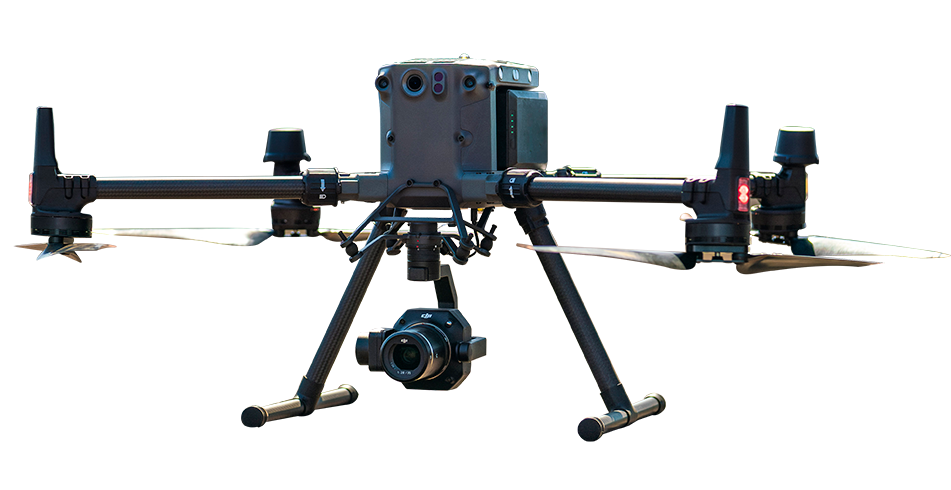
| Enterprise Survey and Inspection | Matrice 400 · Matrice 350 RTK · Matrice 300 RTK · Matrice 4 Series (4T, 4E, 4D, 4TD) · Matrice 30T · Matrice 30 |
| Agriculture | Agras T100 · Agras T50 · Agras T25 |
| Cargo and Delivery | FlyCart 30 · FlyCart 100 |
| Autonomous Stations | Dock 3 · Dock 2 |
| Camera Drones | Mavic 4 Pro · Mini 5 Pro · Air 3S · Avata 2 · Avata 360 · Neo 2 · Mini 4 Pro · Inspire 3 |
| Zenmuse Payloads | H30 Series · L3 · L2 · P1 · H20 · H20T · H20N · S1 · V1 |
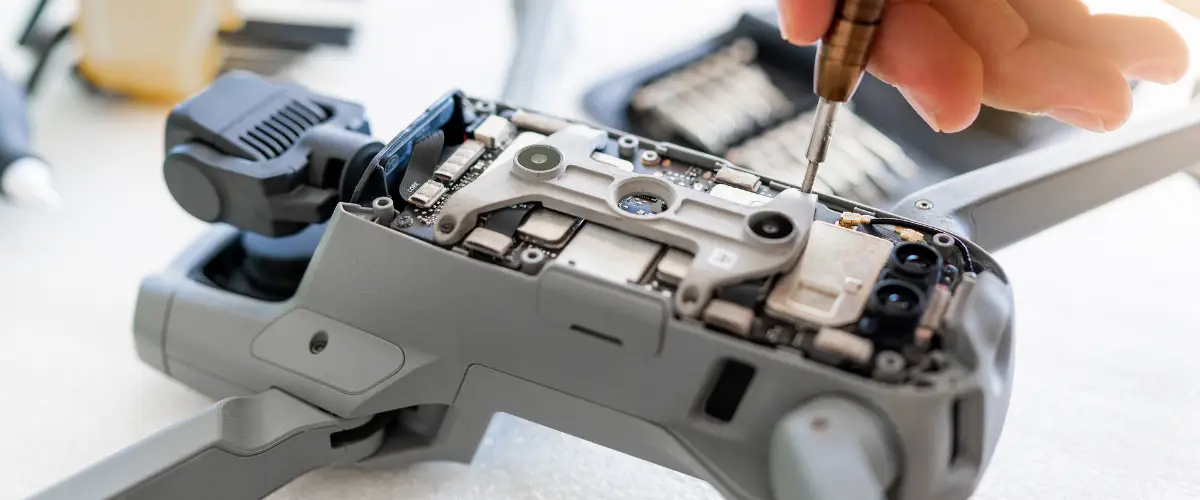
Crash events are the most urgent repair category—and the one where the quality of the repair matters most for subsequent operational safety. Aerosmart Africa's crash repair process begins with a complete structural and internal systems assessment before any repair work is quoted or commenced.
Physical inspection covers frame component damage, motor arm deformation, landing gear condition, gimbal mount integrity, and payload port condition. Internal systems assessment identifies the electrical and electronic damage that physical impact regularly causes without visible external indication—ESC overload damage, IMU impact displacement, GPS antenna connection failure, and the transmission module damage that landing gear and body impacts generate even when the external casing appears intact.
All structural repairs use genuine DJI OEM frame components—not third-party substitute parts whose weight tolerances, dimensional accuracy, and structural rigidity affect flight controller tuning and gimbal stabilisation performance.
Post-repair calibration verifies IMU alignment, compass calibration, gimbal performance, and RTK function before the aircraft returns to operational service. A post-repair flight log review confirms system behaviour against manufacturer specifications.
Motors are the highest-wear mechanical components in any drone, accumulating bearing degradation from continuous vibration loading, winding contamination from agricultural chemical exposure and dust, and the impact damage that contact events produce.
Our motor service covers vibration signature measurement for bearing wear detection, winding resistance testing for coil integrity, visual inspection for housing deformation, and complete motor replacement when assessment confirms degradation beyond serviceable limits.
ESC diagnostics identify the current limiting, thermal management, and motor control parameter drift that develops as controllers age beyond their original specification—before that drift produces the flight instability that brings an operational programme to a halt during a critical deployment.
Propeller assessment covers crack detection, leading-edge chip identification, and balance measurement—identifying the deformation that impact produces on propeller geometry before it creates the vibration signature that damages bearings and reduces gimbal stabilisation performance.
The DJI Agras spray system is the component most directly exposed to the chemically aggressive, dust-loaded, and thermally demanding conditions of active field spraying—and the component whose performance most directly determines whether the drone programme delivers the agronomic outcomes it was purchased to produce.
Aerosmart Africa's Agras spray system overhaul covers the complete flow path from tank to nozzle.
Pump Service: Magnetic drive impeller inspection and replacement. Flow rate measurement against specification. Motor current draw assessment identifying bearing wear and impeller drag that precede pump failure.
Nozzle and Sprinkler Service: Centrifugal disc cleaning and rotation speed verification. Spray angle and distribution pattern check. Water-cooled mist sprinkler cleaning and cooling circuit flush. Complete nozzle assembly replacement when atomisation uniformity has degraded below the agronomic specification that effective crop protection requires.
Flow Rate Calibration: End-to-end flow rate measurement confirming that the spray system delivers the application rate configured in the mission planning the calibration step that ensures the variable-rate prescription the NDVI analysis specifies is actually delivered to the crop at the correct rate rather than a rate that has drifted through component wear.
Tank and Seal Inspection: Chemical residue accumulation assessment, calcium deposit identification, tank material integrity check, and O-ring and gasket replacement where compression set or chemical degradation has compromised seal performance.
For Agras T50 and T100 spreading systems: hopper inspection, spreading disc balance verification, flow rate calibration, and the control system diagnostics that confirm variable-rate spreading performance matches the prescription map the aircraft is executing.
Payloads are where the drone programme's commercial value is generated—and payload performance degradation directly reduces the quality and usability of every data collection flight until the issue is resolved.
Thermal and Multi-Sensor Payloads (H30, H20, H20T, H20N): Gimbal motor and bearing replacement, thermal camera non-uniformity correction calibration, zoom camera optical alignment verification, laser rangefinder calibration, and NIR auxiliary light function testing.
LiDAR Payloads (L2, L3): LiDAR sensor housing inspection, IMU calibration verification, RGB camera gimbal and mechanical shutter inspection, and the precise IMU-to-laser head alignment that survey-grade point cloud accuracy depends on.
Photogrammetry (Zenmuse P1): Full-frame sensor inspection, mechanical shutter function and timing verification, DL lens mount integrity assessment, gimbal calibration, and RTK synchronisation diagnostics for TimeSync 2.0 accuracy.
Communication Payloads (S1, V1): LEP light source assessment for S1. Speaker driver and anti-howling system verification for V1. Gimbal and mounting system integrity check for both.
Field charging in high-ambient-temperature African conditions accelerates battery degradation at rates that temperate-climate charge cycle assumptions significantly underestimate. Our battery service covers cell balance measurement across all cells, internal resistance measurement at defined state-of-charge to identify impedance increase approaching end-of-life, and capacity measurement against original rated capacity to quantify remaining energy storage percentage.
DJI Care Enterprise Plus includes one battery replacement per aircraft per year. Aerosmart Africa activates and manages all Care battery replacement claims, coordinating dispatch and return without client-side claims administration.
Current firmware is a maintenance requirement, not an optional upgrade. DJI releases firmware updates that address safety issues, improve performance, and maintain regulatory compliance. Outdated firmware creates compatibility problems between aircraft and payload, misses safety improvements, and in some cases affects the aircraft's geofencing behaviour in regulated airspace.
Aerosmart Africa performs supervised firmware updates to the current DJI-recommended version for every platform and payload in the system, with post-update calibration verification confirming that the update has not introduced IMU, compass, or gimbal offset requiring recalibration.
Remote software troubleshooting covers DJI Pilot 2 configuration issues, DJI FlightHub 2 connectivity and data upload problems, DJI Terra processing errors, and Dock 3 and FlightHub 2 integration diagnostics. These issues can often be resolved via screen share, video call, and remote access tools without requiring physical device shipment for software-only issues.
The most cost-effective service is the one that prevents the failure before it costs the programme a deployment. Aerosmart Africa's preventive maintenance schedule is calibrated for African operating conditions, accounting for harmattan dust exposure in West Africa, tropical humidity in Central Africa's forest-margin environments, high ambient-temperature field charging across the Sahel and Horn of Africa, and the seasonal usage intensity patterns of agricultural, mining, and inspection drone operations.
| Programme | Interval | Scope |
|---|---|---|
|
Monthly Check
|
Every month | Propulsion visual and electrical inspection, battery balance, gimbal condition, firmware version, and structural fasteners |
|
Quarterly Service
|
Every quarter | Full motor inspection, gimbal motor and bearing replacement on high-cycle platforms, battery internal resistance trending, ESC parameter verification, IP seal condition, and spray system flow-path inspection for Agras platforms |
|
Annual Overhaul
|
Yearly | Complete disassembly inspection, IMU and compass recalibration, all bearing replacement on high-cycle platforms, battery capacity measurement, structural crack inspection, full Agras spray system overhaul, and DJI Care renewal processing |
Comprehensive DJI enterprise protection with repair, replacement, fleet coverage and claims management handled by Aerosmart Africa.
| Benefit | Detail |
|---|---|
|
Unlimited Repairs
|
Free repairs within the annual coverage limit for the full plan duration |
|
Battery Replacement
|
One battery replacement per year for each enrolled aircraft |
|
Fleet Coverage
|
Shared coverage limit across the complete enrolled fleet |
|
Free Two-Way Shipping
|
Return and delivery shipping with no logistics cost on service requests |
|
OEM Components
|
DJI-certified engineers and genuine manufacturer parts used on every repair |
|
Extended Warranty Option
|
An additional one-year warranty is available on major components |
Contact Aerosmart Africa by WhatsApp at +971 50 157 6093 , by email at africa@aerosmart.ae , or by phone with a description of the fault, the aircraft model and serial number, and photographs or video of any visible damage.
Our technical team responds with an initial remote diagnosis, frequently identifying the probable fault from the symptom description and footage. Where possible, we also advise whether remote configuration changes can restore operation while the aircraft awaits physical service.
The remote diagnosis produces a written repair scope and quote covering the assessed faults, required genuine DJI OEM components, estimated repair time, DJI Care Enterprise Plus coverage status, and shipping-arrangement guidance.
No repair work proceeds without written approval of the quote.
Aerosmart Africa provides platform-specific packaging guidance and customs-documentation instructions for outbound shipment from the operator's country to our Dubai service facility.
We advise on the appropriate customs description, HS code, and declared-value approach to support efficient outbound customs clearance from each African source country.
Physical receipt of the aircraft triggers a complete inspection that confirms the remote diagnosis and identifies any additional findings.
Any additional findings outside the approved repair scope are communicated for authorisation before further work proceeds. All repairs are completed by certified DJI technicians using genuine OEM components with documented component traceability.
The post-repair quality protocol covers motor run testing, gimbal sweep and calibration verification, sensor-function confirmation, communication-system testing, and RTK-function checks where applicable.
For agricultural platforms, the verification process also includes Agras spray-system flow-rate testing. Flight-log comparison before and after the repair confirms that post-repair system behaviour meets manufacturer specifications.
Return shipping with complete customs documentation is arranged to the operator's destination country.
After delivery, Aerosmart Africa provides remote commissioning support, guiding the operator through post-repair system verification in DJI Pilot 2, confirming calibration status, and resolving configuration questions before the aircraft returns to operational deployment.
The two repair options that most African enterprise drone operators have historically faced are both inadequate for professional operations: an unauthorised local technician using non-OEM components without proper calibration capability, or international shipping to a European or North American authorised service centre with weeks of round-trip transit time.
These limitations are especially costly where the drone is a revenue-generating asset supporting an active inspection, agricultural, delivery, surveying, or public-safety programme. Aerosmart Africa's authorised service operation from Dubai fills the gap between these inadequate alternatives.
Every repair uses genuine DJI components with the dimensional accuracy, weight tolerances, and electrical specifications around which the aircraft's flight controller was originally tuned.
Third-party components that differ from OEM specifications—even marginally—can affect vibration characteristics, gimbal stabilisation performance, motor efficiency, and flight-controller behaviour.
In structural components, incorrect material properties or dimensional tolerances can also change the aircraft's crash-load response, reducing the protection provided to the airframe and payload during a subsequent impact event.
Our maintenance intervals and service recommendations account for the specific degradation patterns created by African operating environments.
These conditions include harmattan dust ingress rates that can exceed normal IP-rating assumptions, humidity-driven corrosion in equatorial deployments, and accelerated battery degradation caused by high-ambient-temperature charging in field environments.
A maintenance programme designed around European operating conditions may miss the shorter inspection and servicing intervals that African deployments require. Aerosmart Africa calibrates its preventive-maintenance recommendations around the environment, workload, platform type, and operational intensity of each client.
Aerosmart Africa provides authorised DJI enterprise drone repair services across more than 14 African countries. We provide remote diagnostics for all supported markets and mail-in physical repair through our Dubai service facility, with return shipping available to Nigeria, Kenya, Ethiopia, Ghana, Tanzania, Uganda, Rwanda, Zambia, Mozambique, Angola, Botswana, Egypt, Morocco, Senegal and Ivory Coast.
Aerosmart Africa services the complete DJI enterprise range, including the Matrice 400, Matrice 350 RTK, Matrice 300 RTK, Matrice 4 Series, Matrice 30T, Agras T100, T50 and T25, FlyCart 30 and FlyCart 100, DJI Dock 3 and Dock 2, and Zenmuse payloads including the H30 Series, L3, L2, P1, H20, H20T, H20N, S1 and V1.
Aerosmart Africa begins with remote diagnostics through WhatsApp, email or video call. Software, firmware and configuration issues may be resolved remotely without shipping where possible. For physical repairs, operators send the aircraft to our Dubai facility using the customs documentation and packaging guidance provided by our team. After repair, the aircraft is returned with remote commissioning and system-verification support.
Yes. Aerosmart Africa manages the complete DJI Care Enterprise Plus claims process for eligible platforms purchased through us. This includes claim submission, repair or replacement coordination, shipping logistics and delivery of the repaired or replacement equipment to the operator's country without client-side claims administration.
Yes. Our DJI Agras spray-system overhaul covers the complete flow path, including pump inspection and replacement, nozzle and atomiser cleaning, nozzle replacement, flow-rate calibration, tank-seal replacement, water-cooled mist sprinkler servicing and spreading-system calibration for Agras T50 and T100 spreading operations.
Aerosmart Africa aims to respond to remote-diagnosis requests within 24 hours of contact. Physical repairs at our Dubai facility generally take approximately 5 to 10 working days, depending on the fault, required components and repair scope. Total round-trip turnaround time, including shipping and customs clearance, varies by country. Our team provides a realistic estimated timeline when the repair is booked.
Yes. Monthly inspection, quarterly service and annual overhaul preventive-maintenance programmes are available. These programmes are calibrated for African operating conditions, including harmattan dust exposure, tropical humidity, high-ambient-temperature field charging and the seasonal operational intensity of agricultural and industrial drone programmes.
Contact Aerosmart Africa immediately by WhatsApp at +971 50 157 6093 and provide photographs or video of the visible damage. Do not attempt to power on the aircraft if structural or battery damage is visible, because an impact-damaged battery may present a fire risk if charged or operated. Our technical team will provide an immediate remote assessment and safe next-step guidance.

Complete the form below and our drone solutions specialists will contact you with a customised recommendation and quotation based on your operational requirements.